
Disco Inferno: I Learn Through Fire
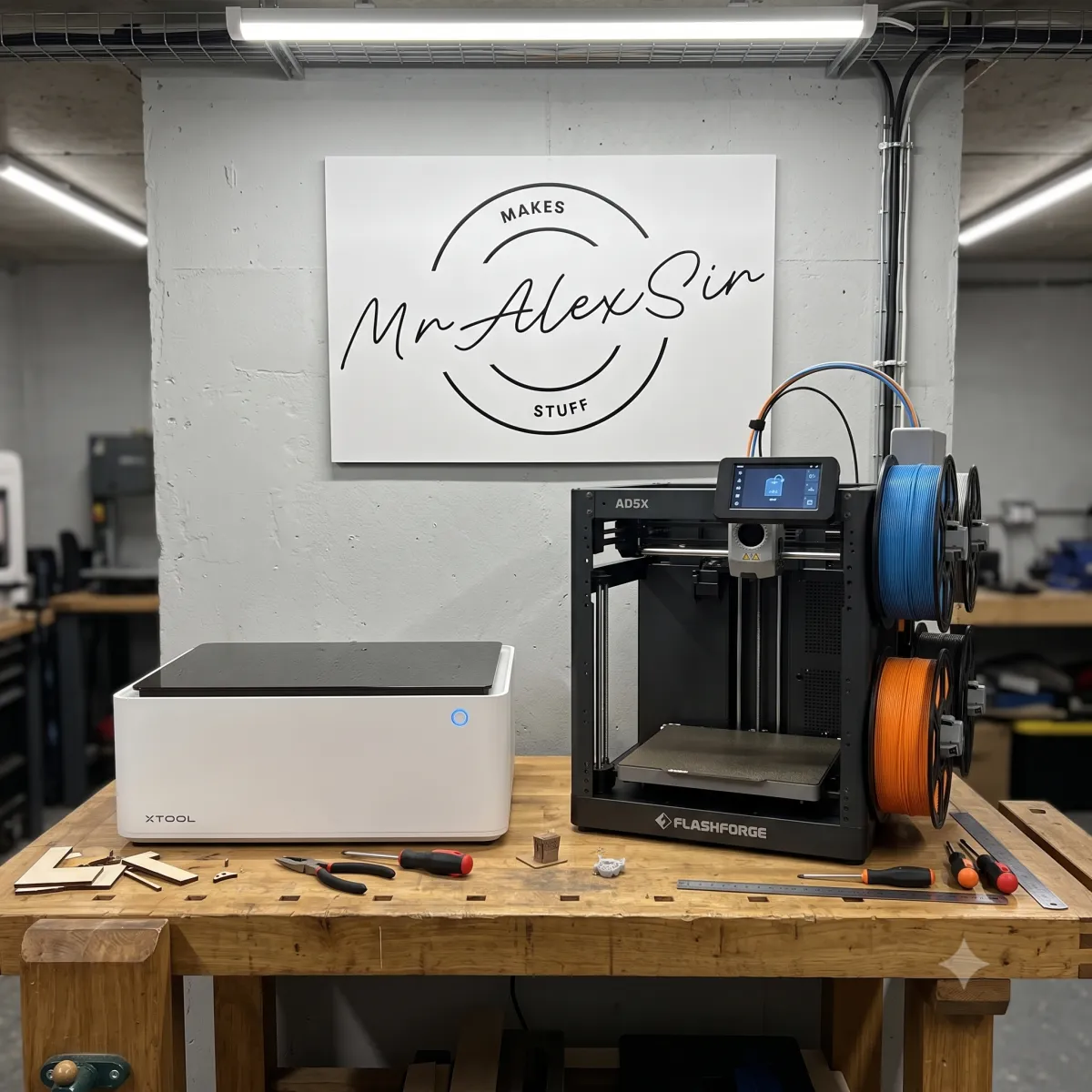
Welcome to the MakerLab logs. If you're reading this, you've wandered away from the pristine shop front and into the back room.
People often ask me how this all started, and the honest answer usually traces back to my day job. By trade, I am an IT engineer. I spend most of my days plugging things into other things to help people work, and the rest of my time on telephone support trying to fix things that are broken.
It is important work, but there is minimal visual satisfaction in it. I could sit at the same desk for 8 hours straight, fix 20 complex problems, and when I stand up at 5pm... I'm still just looking at the exact same three screens. Nothing has physically changed. If I were a builder, I’d be able to look back down the wall at the end of the day and actually see 8 hours of progress. I desperately needed an outlet for my creative side.
Ten years ago, I found it. I bought my first 3D printer—a "Chinese special" second-hand off Facebook Marketplace for less than £100. It barely worked, and what it did manage to print was mostly useless.
But I learned.
I learned about bed levelling, adhesion, layer heights, and squish values. I learned about temperatures, routine maintenance, nozzles, hotends, and the delicate balance of under and over-extrusion. Today, I run a Flashforge AD5X with a built-in AMS (Automatic Material System). It is practically plug-and-play compared to where I started, but the engineer in me still completely relies on the hard lessons learned from those early days of wrangling broken plastic.
It wasn't long before that same problem-solving itch led me to lasers. I was offered an XTool M1 diode laser that was supposedly "broken" because the previous owner couldn't get it to connect properly. I put my IT hat back on, ran some firmware updates, reconfigured the Wi-Fi connections, and got it back up and running perfectly. When they offered to sell it to me at a heavily discounted rate, I snapped their hand off, and my laser journey officially began. At its core, the laser relies on the exact same principle as the 3D printer: a computer takes an image, writes a script, and feeds it to a machine that relentlessly follows the instructions.
Beyond the hardware, my absolute fascination lies in that code: GCode. The fact that a computer can take a digital file, deconstruct it into individual 0.16mm slices, and then produce a language that a machine can read and physically follow to build something out of controlled, molten plastic or focused light... it still completely blows my mind.
But the real magic happens after the machines stop.
The ultimate creative dopamine hit doesn't come from the printer; it comes from the people who receive what the printer makes. Reading the positive reviews, seeing photos of the custom couples statues or baubles sitting in your homes, and knowing that something engineered right here in the UK brought a smile to someone's face—that is the visual satisfaction I was looking for all those years ago.
The lab has grown a lot since that first £100 printer, but the golden rule of the MakerLab remains the same: If it's not perfect, it goes back in the fire.