
Carving Stone with Light: Don't Get Me Started On Slate Coasters
A good friend of mine once warned me:
Beware the work-coated creature, seen stood a couple of feet away from its object of focus, stroking a beard if present, a chin if not, deep in thought. Duck, if their next sentence is "I wonder."
I had been running a series of test burns on wood using the MakerLab’s XTool M1—a trusty 5W diode laser that handles timber beautifully, when the dreaded advert from a selling site popped up. "Rough-hewn pieces of natural slate, delivered tomorrow, to you this time only, dirt cheap. Go on, at this price you'd be silly not to." and before I could stick my fingers in my ears and shout "lalalalala", my brain went "...I wonder...."
48 hours later, a very dusty box, evidently from the back of a shelf that's being cleared out for new stock, arrived full of slatey goodness. One went into the laser, My logo loaded up in the software and I pressed Go, keen to see what happens.
As it turns out, magic happens. But not immediately.
The "Toddler Graffiti" Phase
Let's talk about the failures first. If you visit my house right now, you will find it absolutely littered with ruined slate. They still hold a mug of tea perfectly well, but visually? They look less like "premium bespoke craftsmanship" and more like they were graffiti'd by a toddler who somehow got their hands on a laser pen.
When you are working with natural stone, half the fun is in seeing what actually happens. If you rush through the alignment of the slate, the design is crooked. If you don't measure the exact depth between the laser lens and the uneven surface of the stone, the beam loses focus, similarly if your speed-to-power ratio is off, you get a muddy, scorched mess instead of crisp typography.
It took hours of burning, tweaking, and binning coasters to finally dial in the exact algorithmic sweet spot...For this batch.
How it Actually Works
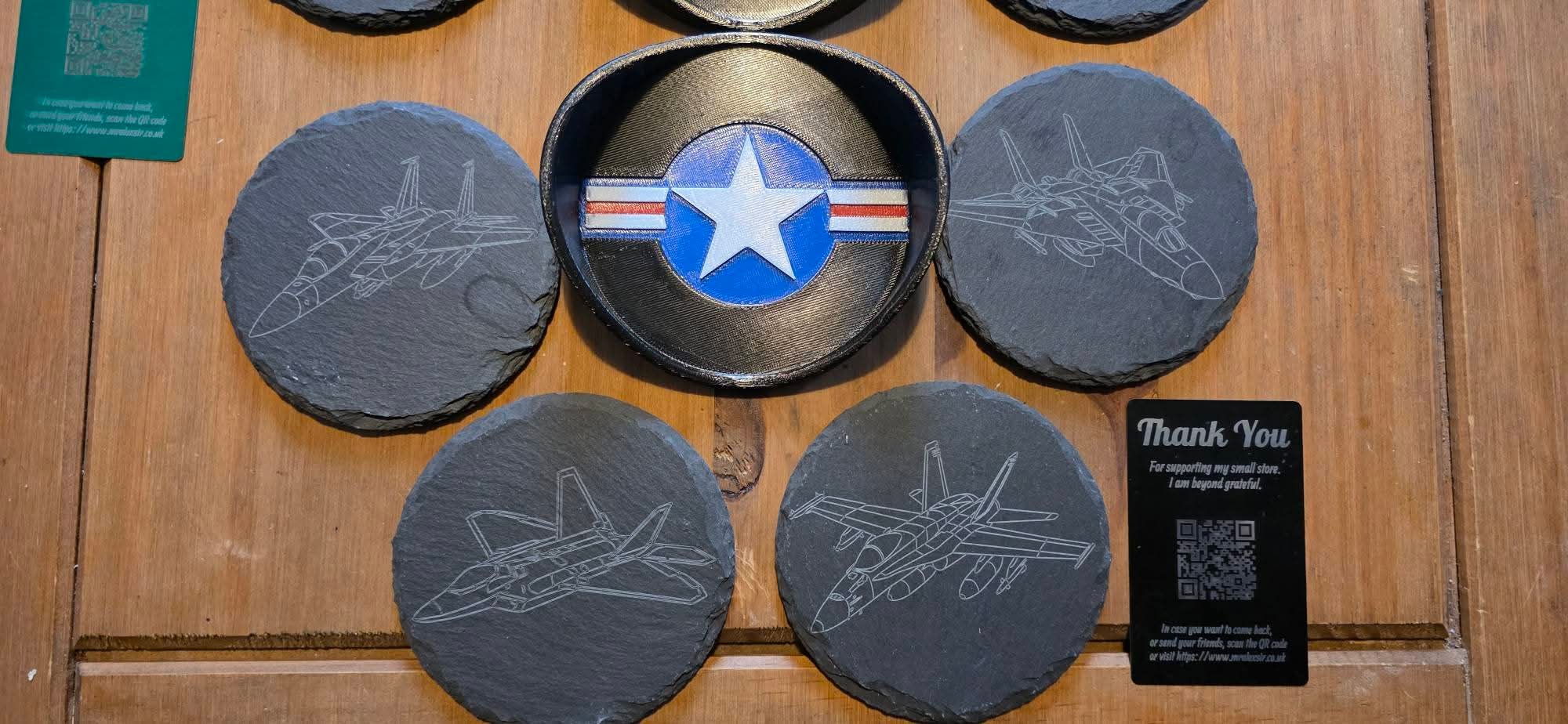
A 5W diode laser isn't going to slice through a solid piece of rock. But when the settings are absolutely perfect, the intense heat of the beam vaporizes just the very top microscopic layer of the slate.
It doesn't leave a deep gouge. Instead, it etches away the dark surface to reveal a clean, strikingly pale image underneath. Because the laser physically alters the stone, the resulting typography and design are totally permanent—they will never fade, peel, or wash away. The rest of the slate remains completely intact and untouched.
Engineering the Base
Once I had the coasters perfected, I realised I couldn't just ship a stack of loose rocks. They needed a home.
I fired up Tinkercad and engineered a custom holder from scratch. Rather than using standard, brittle plastics, I 3D print these bases using PETG. It’s a much tougher, more resilient filament that easily handles the weight of four solid slate coasters. I spent a good amount of time tweaking the tolerances to ensure the fit is just right—snug enough that they don't rattle, but loose enough that you don't have to fight the holder to get your coaster out.
The Couples Coasters and Family Coaster Sets are officially live on the shop now.
And speaking of lasers... the M1 is doing a stellar job, but I might just be eyeing up an upgrade to the 20W XTool M2 (which brings inkjet printing into the mix) just in time for the Christmas bauble rush.
Watch this space.